Selecting the correct brick size is an important part of designing and maintaining a reliable cement kiln lining. For cement producers, refractory distributors, and engineering contractors, the dimensions of kiln bricks directly affect installation accuracy, lining stability, thermal performance, and service life. Different kiln diameters and refractory materials require different brick profiles to ensure that the lining forms a proper cylindrical structure.
For cement kiln refractory materials, standard brick dimensions are mainly associated with two major brick systems: the ISO type, commonly used for high alumina, fireclay, and silica-mullite bricks, and the B type, widely used for basic refractory bricks such as magnesia-chrome and magnesia-alumina spinel bricks. Understanding these standard dimensions makes it easier to select refractory bricks according to kiln diameter and application area.
Standard Systems for Cement Kiln Refractory Materials
The commonly referenced standards for cement kiln refractory materials include GB/T 17912-2014 for general rotary kilns and JC/T 2598-2021 for cement preheater and precalciner kilns. These standards provide standardized dimensional systems for different types of rotary kiln refractory bricks.
The two major dimensional systems are ISO type and B type.
ISO-type bricks have a nominal large-end width of 103 mm. They are commonly associated with high alumina bricks, fireclay bricks, and silica-mullite or similar alumina-silicate refractory products.
B-type bricks use a different dimensional configuration and are mainly associated with basic refractory materials. These include magnesia-chrome bricks and magnesia-alumina spinel bricks, which are widely used in demanding cement kiln zones.
Standard dimensions are generally expressed as:
h × (a/b) × l
Here, h represents the brick height, a/b represents the large-end and small-end widths, and l represents the brick length. For example, a dimension of 220 × (75/68) × 198 mm means that the brick is 220 mm high, 75 mm wide at the large end, 68 mm wide at the small end, and 198 mm long.
Common ISO-Type Brick Dimensions
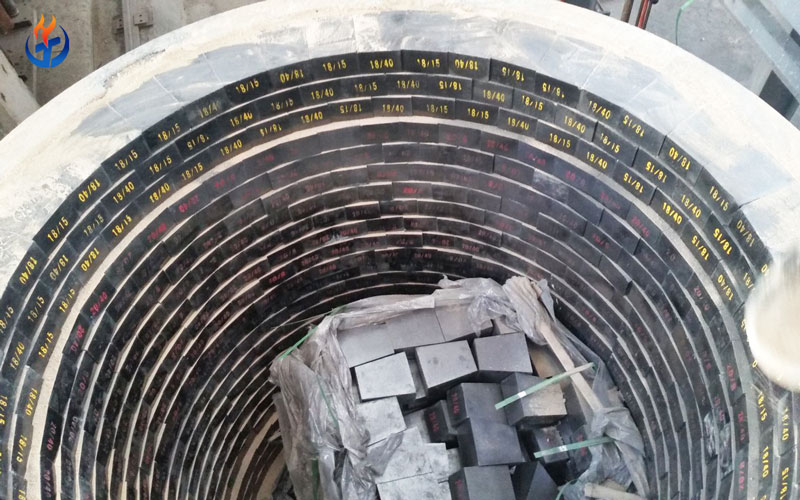
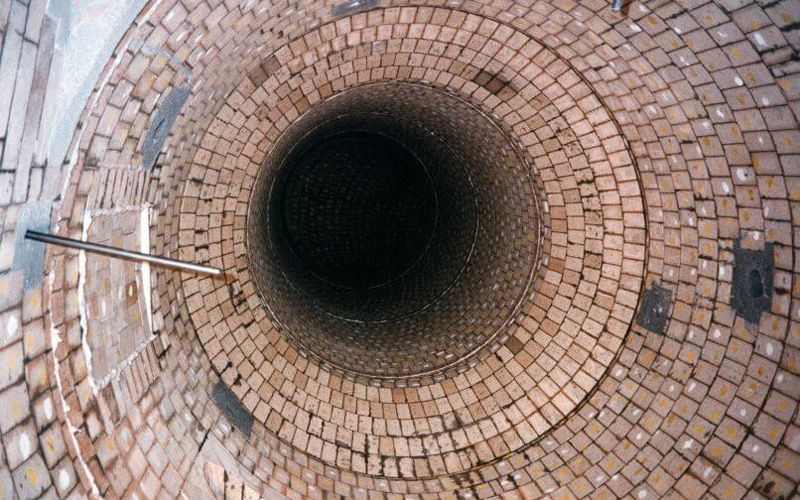
ISO-type refractory bricks are widely used in cement kiln linings because their tapered profile allows individual bricks to form a circular lining inside the rotary kiln.
The large-end width of the ISO system is generally 103 mm. Different brick numbers are designed for different kiln diameters.
| Brick No. | Standard Dimensions (mm) | Typical Kiln Diameter |
|---|---|---|
| 320 | 200 × (103/89) × 198 | 3.0–3.5 m |
| 420 | 200 × (103/92.5) × 198 | 4.0–4.5 m |
| 422 | 220 × (103/91.5) × 198 | 4.0–4.5 m |
| 520 | 200 × (103/94.7) × 198 | 5.0–5.5 m |
| 620 | 200 × (103/96.2) × 198 | 6.0–6.5 m |
One important characteristic can be observed from these dimensions. As the kiln diameter increases, the difference between the large-end and small-end widths generally becomes smaller. This means that larger-diameter kilns require a smaller taper angle to create the circular lining geometry.
For example, the ISO 320 brick has a relatively larger difference between its two widths, while the ISO 620 brick has a smaller difference. This dimensional relationship allows the refractory lining to fit the internal curvature of different rotary kilns.
Common B-Type Brick Dimensions
B-type bricks are commonly used with basic cement kiln refractory materials, particularly magnesia-based products. Their dimensional design differs from the ISO system and is suitable for applications where basic refractories are required.
Typical examples include:
| Brick No. | Standard Dimensions (mm) | Typical Kiln Diameter |
|---|---|---|
| B320 | 200 × (76.5/66.5) × 198 | Around 3.0 m |
| B322 | 220 × (76.5/66.5) × 198 | Around 3.0 m |
| B422 | 220 × (75/68) × 198 | Around 4.0 m |
| B620 | 200 × (74/69) × 198 | Around 6.0 m |
| B622 | 220 × (74/69) × 198 | Around 6.0 m |
B-type bricks are especially relevant when selecting magnesia-chrome or magnesia-alumina spinel refractory products for cement kilns. Their dimensional design must correspond closely to the kiln shell diameter and the specific lining structure.
The correct brick profile is important because an unsuitable taper can create excessive gaps or installation stress. These problems may reduce lining stability and increase the risk of brick movement during kiln operation.
Standard Straight Brick T-3
Not every section of a cement kiln requires tapered bricks. Straight sections and specific kiln areas may use standard straight refractory bricks.
A commonly used straight brick is the T-3 type, with dimensions of:
230 × 114 × 65 mm
T-3 bricks can be used in areas such as kiln mouths, cooling zones, and other relatively straight sections where a tapered rotary-kiln brick is not required.
When selecting cement kiln refractory materials, it is therefore important to consider not only the kiln diameter but also the exact installation area. The brick shape required for a circular burning zone may be very different from that required for a straight or transition section.
Brick Dimensions and Manufacturing Tolerances
Standardized dimensions are essential for consistent refractory installation. However, refractory bricks are manufactured ceramic products, so reasonable dimensional tolerances must be considered during production and quality inspection.
The dimensional representation follows the h × (a/b) × l format. For example:
220 × (75/68) × 198 mm
represents the brick’s height, large-end width, small-end width, and length.
Typical dimensional tolerances may include a height tolerance of approximately ±2%, with a practical limit of around ±2 mm, width tolerance of approximately ±2 mm at the large and small ends, and length tolerance of approximately ±2 mm.
For large cement kiln projects, dimensional consistency is particularly important because hundreds or thousands of refractory bricks may be installed in a single lining. Small dimensional differences between individual bricks can accumulate during installation and affect the final lining structure.
Therefore, buyers should confirm both the nominal brick dimensions and the manufacturer’s actual dimensional tolerance before placing an order.
Special Bricks for Precalciner Cement Kilns
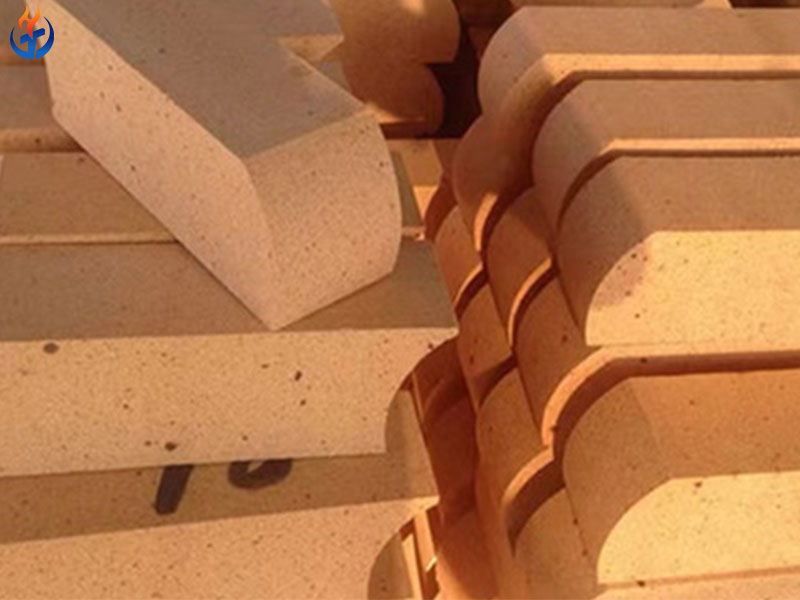
Modern precalciner cement kilns can require additional brick shapes beyond the traditional ISO and B systems. JC/T 2598-2021 includes dimensional categories designed for specific applications in cement preheater and precalciner kiln systems.
One example is the C type, which uses a nominal intermediate width of approximately 78.5 mm. A representative specification is:
C201: 200 × (84/73) × 198 mm
There are also specialized locking bricks, such as CS-type bricks, which can be used to improve the stability of certain refractory lining structures.
These special shapes are useful where conventional tapered bricks cannot provide the required lining configuration. Their selection should be based on the kiln design, lining drawing, installation method, and the requirements of the specific kiln zone.
Conclusion
Standardized dimensions make it easier to select and install cement kiln refractory materials for different rotary kiln designs. ISO-type bricks with a 103 mm large-end width are commonly associated with alumina-silicate refractory products, while B-type bricks are widely used for basic refractory materials such as magnesia-based bricks.
Common brick numbers such as 320, 420, 422, 520, 620, B320, B422, and B622 cover different kiln diameters and lining requirements. Standard straight T-3 bricks and specialized C-type and CS-type bricks can be used in specific kiln sections where different geometries are required.
For refractory buyers and cement plant engineers, the most important principle is to match brick profile, dimensions, refractory composition, kiln diameter, and installation zone as a complete system. Correct dimensional selection helps create a stable lining, reduce installation problems, and support the long-term performance of cement kiln refractory materials.