Low cement castables are high-performance monolithic refractory materials developed to provide better high-temperature performance than conventional castables while using a significantly lower amount of calcium aluminate cement. In general, a low cement castable contains less than 2.5% CaO, and the calcium aluminate cement addition is approximately one-half to one-third of that used in ordinary castables.
Unlike conventional castables that mainly depend on cement hydration for bonding, low cement castables use ultrafine powders with chemical compositions similar or close to the main refractory materials. These fine powders provide a cohesive bonding effect and partially replace calcium aluminate cement. As a result, the final refractory structure combines hydraulic bonding and coagulation bonding, creating a dense structure with improved high-temperature properties.
Based on the main refractory raw materials used, low cement castables can generally be divided into three types: corundum low cement castables, high alumina low cement castables, and clay low cement castables. Each type has different temperature resistance, physical properties, and application requirements.
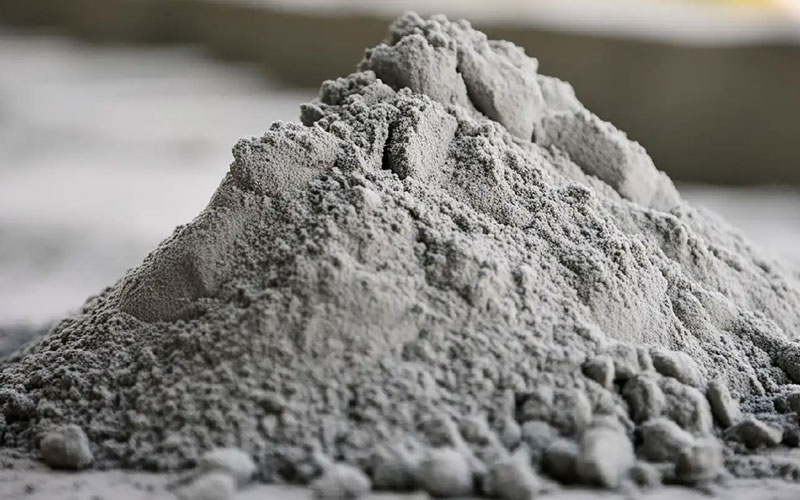
What Are Low Cement Castables?
The main characteristic of low cement castables is their reduced calcium aluminate cement content. Traditional castables require relatively high cement additions to achieve sufficient green strength after mixing and curing. However, excessive cement can introduce more CaO into the refractory matrix. At elevated temperatures, CaO may react with other components and promote the formation of low-melting phases.
Low cement castables reduce this problem by replacing part of the cement with reactive ultrafine powders. The fine particles improve particle packing, reduce open pores, and create a denser matrix after curing and heat treatment. Because less mixing water is required, the resulting castable can achieve lower porosity and higher bulk density.
The lower water demand is another important advantage. During installation, the mixing water required for low cement castables can be approximately one-third to one-half of that required by conventional castables. Less water means fewer pores remain after drying and firing, which can improve mechanical strength, corrosion resistance, and overall service performance.
1. Corundum Low Cement Castables
Corundum low cement castables are the highest-temperature type among the three common categories. With corundum as the principal refractory raw material, these castables can generally be used at temperatures of around 1700°C, depending on the formulation and operating conditions.
Corundum has excellent refractoriness and good resistance to high-temperature deformation. When combined with a low-cement bonding system, it forms a dense refractory structure with relatively low levels of calcium-containing phases. This makes corundum low cement castables suitable for demanding high-temperature environments where thermal stability, mechanical strength, and resistance to molten materials are important.
The low CaO content helps reduce the formation of low-melting compounds during high-temperature operation. At the same time, the optimized particle-size distribution and ultrafine powder system can improve packing density and reduce the amount of open porosity.
Corundum low cement castables are therefore commonly considered for high-temperature linings and areas exposed to severe thermal and chemical conditions. They are particularly useful where ordinary cement-rich castables may not provide sufficient hot strength or resistance to molten slag and other aggressive materials.
2. High Alumina Low Cement Castables
High alumina low cement castables use high-alumina refractory aggregates and powders as their primary components. Their typical service temperature is approximately 1400–1600°C, depending on the alumina content, formulation, installation method, and operating environment.
The combination of high alumina raw materials and a low-cement matrix provides a balance between refractory performance, mechanical strength, and cost. Compared with ordinary castables, the reduced cement content helps lower the amount of CaO introduced into the material. This can improve high-temperature strength and resistance to slag attack.
Another important feature of high alumina low cement castables is their relatively low porosity. The optimized particle grading allows coarse aggregates, fine powders, and ultrafine particles to pack more closely together. With less mixing water required during installation, fewer pores are generated after drying and firing.
High alumina low cement castables can be used in various industrial thermal equipment where reliable resistance to high temperature and chemical attack is required. Depending on the specific formulation, they can be designed for different working conditions and installation methods.
3. Clay Low Cement Castables
Clay low cement castables are formulated primarily with clay-based refractory materials and are generally suitable for operating temperatures of around 1350°C. Among the three types, they are designed for comparatively moderate temperature conditions while still benefiting from the structural advantages of low cement technology.
The reduced cement content helps lower CaO levels and minimize the formation of unfavorable low-melting phases. The use of fine and ultrafine powders also contributes to a more compact matrix, which can improve density and reduce porosity.
Clay low cement castables can provide good thermal stability and mechanical performance for applications where the operating temperature does not require the higher-temperature capability of corundum or high alumina formulations. Their performance can be further adjusted through the selection of raw materials, particle-size distribution, additives, and bonding systems.
For industrial users, selecting a clay low cement castable should be based on the actual operating temperature, chemical environment, abrasion conditions, installation method, and required service life.
Key Advantages of Low Cement Castables
The three types of low cement castables differ in their main raw materials and service temperatures, but they share several important advantages.
First, their low CaO content reduces the possibility of generating excessive low-melting phases. This can contribute to higher refractoriness, better hot strength, and improved resistance to molten slag and chemical corrosion.
Second, low cement castables require significantly less mixing water during installation. The lower water demand helps reduce porosity and increase bulk density. A denser refractory structure generally provides better resistance to penetration by molten materials and can improve mechanical durability.
Third, less cement hydration occurs during curing. Conventional castables can contain a relatively large amount of hydrated cement phases, which may cause a temporary reduction in strength during intermediate-temperature heating as hydration bonds break down. With low cement castables, fewer hydration products are present, so the material can develop strength more progressively as the temperature increases.
Finally, the formulation can be adjusted to produce self-flowing castables or pumpable castables. This provides greater flexibility during installation and allows manufacturers to develop materials for different construction conditions and lining geometries.
Conclusion
Low cement castables are designed to combine reduced calcium aluminate cement content with optimized refractory aggregates, fine powders, and ultrafine powders. Their low CaO content, low water requirement, dense structure, and improved high-temperature performance make them an important option for modern monolithic refractory linings.
The three main types—corundum, high alumina, and clay low cement castables—serve different temperature and application requirements. Corundum types can generally withstand temperatures of around 1700°C, high alumina types are commonly used at approximately 1400–1600°C, and clay types are generally suitable for around 1350°C.
By selecting the appropriate raw materials and bonding system, low cement castables can be customized for different industrial operating conditions. Xintai Refractory provides low cement castable solutions for customers requiring refractory materials with suitable composition, performance, and installation characteristics.