In modern continuous casting operations, the submerged entry nozzle (SEN) is a critical refractory component that directly influences steel cleanliness, casting stability, and overall production efficiency. As steel plants pursue higher casting speeds, improved safety standards, and reduced downtime, traditional nozzle systems are increasingly challenged. This has led to the development of the Quick Change Submerged Entry Nozzle (Quick Change SEN) — an advanced solution designed to improve operational flexibility and minimize interruptions.
This article provides a comprehensive comparison between the Quick Change Submerged Entry Nozzle and the ordinary submerged entry nozzle, examining their structural design, installation process, operational efficiency, safety performance, maintenance requirements, economic impact, and suitable applications. The goal is to help steel manufacturers better understand which system aligns with their production objectives.
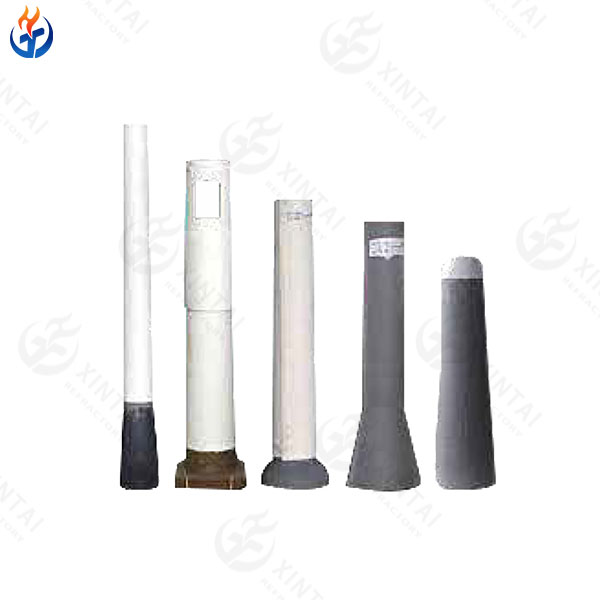
Overview of the Ordinary Submerged Entry Nozzle
A conventional submerged entry nozzle is installed between the tundish and the mold during continuous casting. Its main functions include:
Delivering molten steel from tundish to mold
Preventing secondary oxidation
Controlling steel flow direction and velocity
Reducing slag entrainment
Stabilizing the meniscus level
Ordinary SENs are typically manufactured using high-performance refractory materials such as alumina-graphite or zirconia-carbon composites to resist high temperatures, thermal shock, and chemical corrosion.
However, while conventional SENs perform reliably in many operations, they present challenges during replacement, especially in high-speed casting lines.
1. What Is a Quick Change Submerged Entry Nozzle?
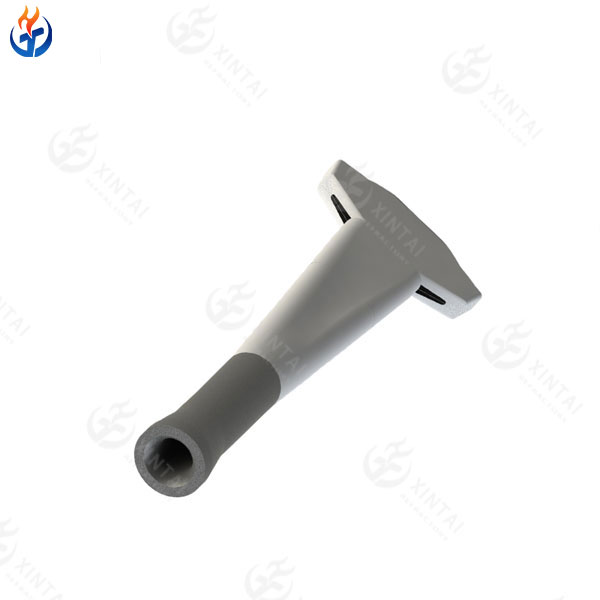
The Quick Change Submerged Entry Nozzle is an upgraded SEN system designed to allow rapid and safe replacement with minimal interruption to the casting process. Unlike traditional fixed installation designs, the quick change version incorporates a modular structure and a mechanical locking mechanism that simplifies removal and installation.
The core innovation lies in its engineered connection system between the tundish upper nozzle and the SEN body. This system enables operators to remove a worn or clogged nozzle quickly and replace it with a new one without lengthy shutdown procedures.
This advancement significantly improves casting continuity and production efficiency.
3. Structural Differences
3.1 Ordinary SEN Structure
A conventional submerged entry nozzle generally consists of:
Upper connection section
Main refractory body
Discharge ports
External protective coating
The connection to the tundish is typically secured by mechanical fastening, refractory cement, or fixed locking mechanisms. This rigid installation requires manual disassembly during replacement.
Because of this fixed structure, replacing the nozzle can be time-consuming and labor-intensive.
3.2 Quick Change SEN Structure
The Quick Change Submerged Entry Nozzle features a modular and precision-engineered design that includes:
Quick-lock or clamp-type interface
Alignment positioning system
High-precision contact surfaces
Specialized sealing components
Optimized mechanical support
The modular design allows the SEN to be disconnected and replaced efficiently while maintaining reliable sealing performance.
Instead of a fully fixed structure, the quick change system emphasizes mechanical efficiency and operational flexibility.
4. Installation and Replacement Time
4.1 Ordinary SEN Replacement
Replacing a traditional submerged entry nozzle often requires:
Stopping or significantly slowing down casting
Removing fastening devices
Cleaning the connection interface
Installing the new nozzle
Securing and re-aligning components
This process may take between 30 to 60 minutes or longer, depending on site conditions and safety procedures.
Extended replacement time leads to:
Production losses
Heat loss in molten steel
Increased labor cost
Higher risk of casting instability
4.2 Quick Change SEN Replacement
With a Quick Change Submerged Entry Nozzle, replacement time can often be reduced to 5–15 minutes.
Advantages include:
Shorter casting interruption
Reduced heat loss
Faster response to clogging
Improved overall productivity
In high-capacity steel plants, reducing replacement time even by 20 minutes per event can translate into significant annual output increases.
5. Safety Considerations
Safety is a major factor in continuous casting operations due to extreme temperatures and molten steel handling.
Ordinary SEN
Requires extended manual work near high-temperature zones
Higher exposure time during replacement
Increased risk of molten steel leakage if sealing fails
Greater physical workload for operators
Quick Change SEN
Minimizes operator exposure time
Simplifies mechanical operations
Reduces risk of sealing failure
Enhances mechanical stability
The quick change system contributes to safer working conditions by reducing the duration and complexity of high-risk operations.
6. Sealing Performance and Leakage Prevention
Proper sealing between the tundish and SEN is critical to prevent air infiltration and steel leakage.
Ordinary SEN Sealing
Traditional systems rely heavily on refractory cement or mechanical tightening pressure. Over time, sealing surfaces may degrade due to:
Thermal cycling
Slag erosion
Steel infiltration
Mechanical wear
Sealing degradation can lead to:
Air suction
Oxidation of molten steel
Inclusion formation
Quality defects
Quick Change SEN Sealing
The Quick Change Submerged Entry Nozzle uses:
Precision-machined interfaces
Engineered sealing components
Improved contact surface alignment
These features provide:
More consistent airtight sealing
Reduced risk of air ingress
Improved molten steel cleanliness
This is especially important in the production of high-quality steel grades such as automotive steel, bearing steel, and pipeline steel.
7. Operational Flexibility
Ordinary SEN Limitations
Traditional SEN systems offer limited flexibility. If clogging occurs during casting, operators may delay replacement due to time-consuming procedures, potentially compromising steel quality.
Additionally, frequent steel grade changes can increase operational complexity when using fixed installation systems.
Quick Change SEN Advantages
The Quick Change Submerged Entry Nozzle offers:
Mid-sequence replacement capability
Faster reaction to clogging problems
Greater adaptability to different steel grades
Improved casting stability
This flexibility is particularly valuable in plants producing multiple steel grades within short production cycles.
Key Differences Summary
| Aspect | Ordinary SEN | Quick Change SEN |
|---|---|---|
| Replacement Time | 30–60 minutes | 5–15 minutes |
| Installation Method | Fixed mechanical or cemented | Modular quick-lock system |
| Downtime | Higher | Significantly reduced |
| Safety Level | Moderate | Improved |
| Sealing Reliability | Traditional method | Precision-engineered sealing |
| Operational Flexibility | Limited | High |
| Initial Cost | Lower | Higher |
| Long-Term Efficiency | Moderate | High |
Conclusion
The difference between a traditional submerged entry nozzle and a Quick Change Submerged Entry Nozzle is not merely structural — it represents a strategic upgrade in continuous casting operations.
While ordinary SENs remain suitable for certain production environments, the Quick Change Submerged Entry Nozzle offers substantial advantages in efficiency, safety, flexibility, and long-term cost performance. By reducing replacement time, improving sealing reliability, and minimizing casting interruptions, the quick change system supports higher productivity and better steel quality.
For steel manufacturers aiming to enhance operational stability and meet modern production demands, understanding these differences is essential. As casting technology continues to evolve, quick change solutions are increasingly becoming a preferred standard in advanced steelmaking facilities.