Boilers are essential components in industrial processes, power generation, and marine applications. They operate under extremely high temperatures, mechanical stress, and corrosive environments, making the selection of the right boiler refractory material crucial for efficiency, safety, and longevity. Refractory materials not only contain heat generated by fuel combustion but also protect the boiler’s structural components, reduce heat losses, and resist chemical attack from ash, slag, and flue gases.
Understanding the different boiler refractory material types is essential for engineers, maintenance teams, and industries aiming to maximize boiler efficiency while reducing operational costs. This article explores the key types of boiler refractory materials, their properties, applications, and best practices for installation and maintenance.
Importance of Boiler Refractory Materials
The main purpose of boiler refractory materials is to:
Contain and control heat: Efficiently retain heat within the furnace and minimize heat loss.
Provide insulation: Reduce energy consumption by limiting heat transfer to the boiler’s outer shell.
Protect structural components: Prevent thermal and chemical damage to steel walls, tubes, and water walls.
Withstand mechanical and chemical stresses: Resist abrasion, erosion, vibration, flue dust, and slag deposits.
A high-quality boiler refractory material must meet several critical requirements, including:
High melting point (1800°C–2800°C depending on material composition).
Mechanical strength to bear weight, vibration, and abrasive action.
Thermal expansion compatibility to prevent cracking during temperature fluctuations.
Resistance to chemical corrosion from fuels and flue gases.
Key Properties of Boiler Refractory Materials
Before selecting a boiler refractory material, it is essential to understand the properties that define its performance:
Refractoriness: The temperature at which a refractory deforms under its own load. Materials with higher refractoriness can withstand extreme furnace conditions.
Porosity: Low porosity ensures high strength and better thermal conductivity while resisting chemical attack.
Refractory strength: The ability to withstand compressive, tensile, and shear stresses.
Spalling resistance: The material’s capacity to resist fracture caused by thermal and mechanical stress.
Thermal conductivity: Determines how much heat the material allows to pass through. Insulating materials have low thermal conductivity.
Thermal expansion: Indicates how the material expands when heated and contracts when cooled. Uniform expansion prevents cracking.
Bulk density and specific gravity: High-density materials are typically stronger and more durable.
Classification of Boiler Refractory Materials
Refractory materials for boilers are generally classified based on composition into three main groups:
Acidic Refractories: Made from silica, clay, quartz, and sandstone. Suitable for environments where the slag or ash is acidic.
Neutral Refractories: Include chromite, graphite, alumina, and plumbago. Resistant to both acidic and basic conditions.
Basic (Alkaline) Refractories: Composed of magnesia, lime, and zirconia. These materials are ideal for alkaline slag or ash environments.
It is important to avoid mixing acidic and basic refractory materials in the same furnace area, as they can react at high temperatures and reduce the effectiveness of the lining.
Types of Boiler Refractory Materials
1. Fire Bricks
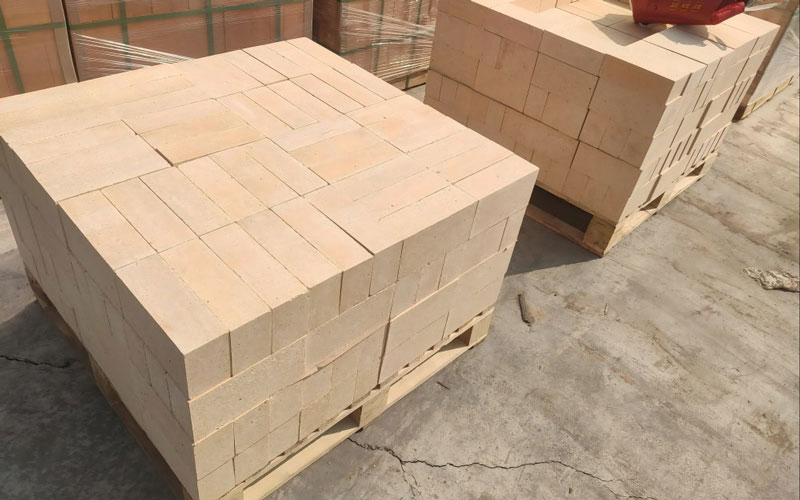
Fire bricks are pre-fired refractory bricks made from clay, alumina, or other refractory compounds. They are one of the most commonly used boiler refractory materials due to their durability and ease of installation.
Advantages:
High strength and heat resistance
Low maintenance requirements
Reliable performance under long-term service
Applications:
Combustion chambers
Furnace walls in lower-temperature zones
2. Monolithic Refractories
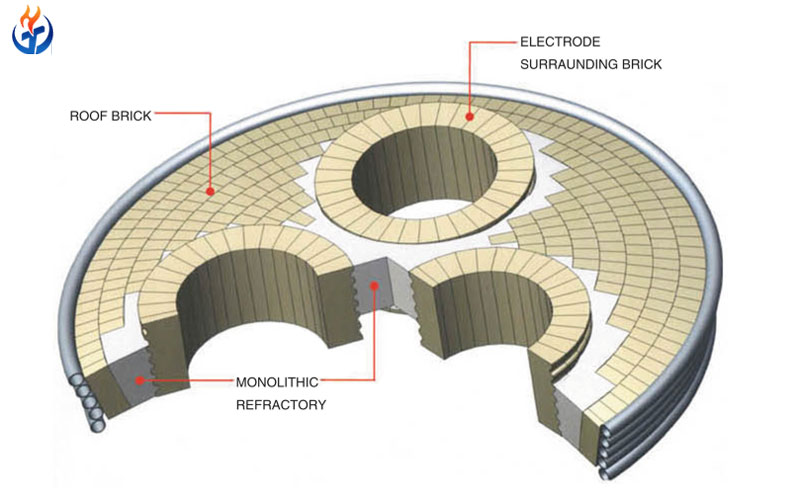
Monolithic refractories are supplied in an unfired state and shaped on-site. They are versatile and can be adapted to complex boiler geometries. Monolithic refractory materials are divided into:
a) Moldable Refractories
Installed in areas directly exposed to radiant heat.
Pounded into place during installation for precise shaping.
Advantages:
High density and quality formulation
Efficient performance and low maintenance
b) Castable Refractories
Used where direct radiant heat exposure is limited, such as behind water walls.
Installed like concrete and then cured in place.
Advantages:
Long operational life
Dimensional accuracy
High strength
c) Plastic Chrome Core Refractories
Bonded with clay and used for constructing studded water walls.
Can withstand extreme temperatures but have low mechanical strength.
Pounded onto steel studs welded to boiler tubes, which provide additional support.
Advantages:
High corrosion resistance
High refractoriness and temperature tolerance
3. High Alumina Bricks
High alumina bricks contain 50–90% Al₂O₃, making them ideal for high-temperature zones in the boiler.
Applications:
Furnace arches
Superheater zones
Biomass and coal-fired boilers
Advantages:
Excellent thermal shock resistance
Long lifespan under extreme conditions
Limitations:
Higher cost than fire clay bricks
4. Silicon Carbide Refractories
Silicon carbide refractories are extremely durable and resistant to abrasion, corrosion, and high temperatures.
Applications:
Ash hoppers
Cyclone burners
Waste-to-energy boilers
Advantages:
Long service life in harsh environments
High abrasion and chemical resistance
Limitations:
High initial cost
5. Insulating Castables
Lightweight castables use materials like vermiculite to reduce thermal conductivity, improving energy efficiency.
Applications:
Boiler walls and doors
Zones requiring insulation rather than mechanical strength
Advantages:
Low heat storage
Fast installation
Energy-efficient
Limitations:
Lower mechanical strength compared to dense refractories
Precautions During and After Installation
Proper installation and maintenance are essential to maximize the life of boiler refractory materials:
Allow for thermal expansion: Space must be provided for expansion to avoid bulging or cracking.
Control steam-raising speed: Rapid heating can damage refractory materials.
Avoid cold air impingement: Close dampers during shutdown to prevent spalling.
Prevent flame impingement: Direct flame can cause carbon deposition and surface damage.
Reduce fuel impurities: Vanadium or sodium salts can form molten slag, decreasing refractory lifespan.
Common Causes of Boiler Refractory Damage
Improper installation or wrong refractory selection
Rapid cooling or thermal shock
Excessive mechanical, structural, or thermal stress
High furnace temperatures due to loss of control
Corrosion from cold spots or chemical reactions
Vibration and erosion from operational errors
Conclusion
Choosing the right boiler refractory material is critical for the safe and efficient operation of boilers. Fire bricks, high alumina bricks, silicon carbide, and insulating castables each have their specific applications and advantages. Engineers and maintenance teams must carefully consider operating temperatures, chemical environments, mechanical stress, and thermal conductivity before selecting materials. Proper installation, regular inspection, and preventive maintenance will extend refractory lifespan, optimize boiler efficiency, and reduce operational costs.
Investing in high-quality refractory materials and following best practices ensures that boilers operate safely, efficiently, and with minimal downtime. By understanding the types of boiler refractory materials and their properties, industries can enhance performance and protect their valuable assets.
Looking for refractory materials for boilers and other refractory materials? Welcome to Get more from Xintai refractory!